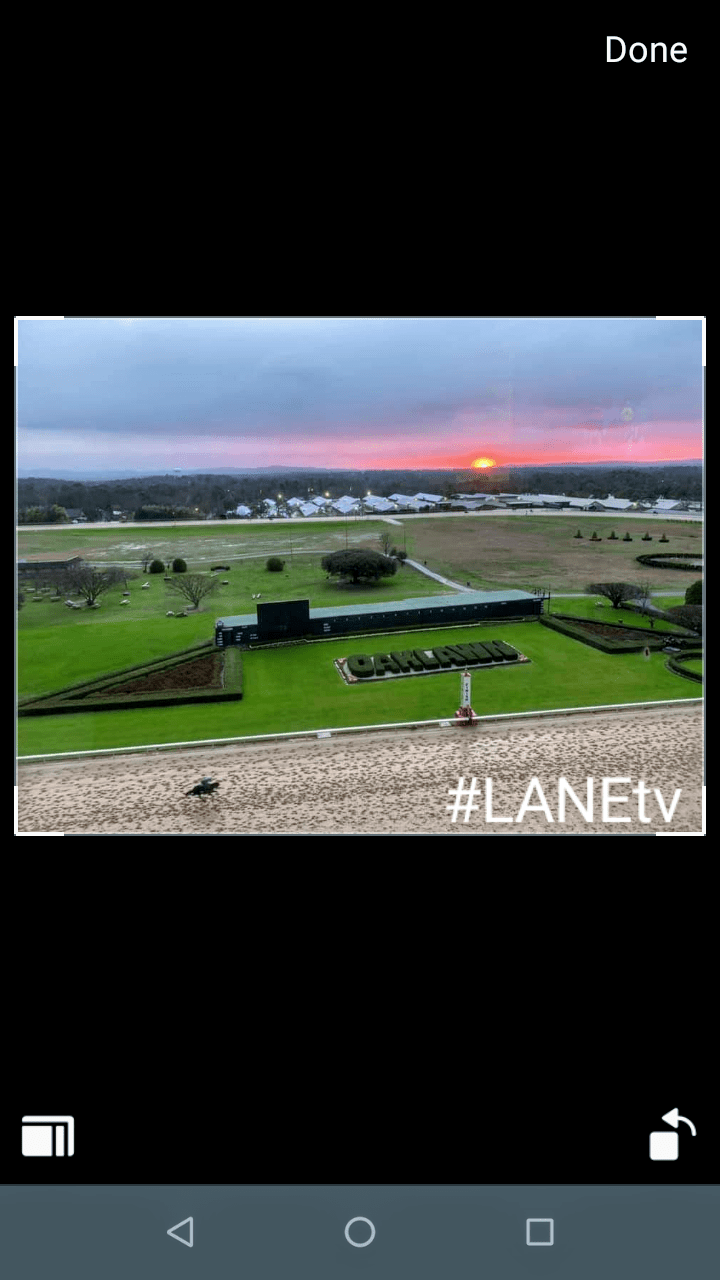
New jockeys, trainers and owners flocked toOaklawn Parkin Hot Springs, Ark., for the 2020 meet to compete against elite regulars, hoping to bank some of the richest purses in the country offered this time of year. Their barns are filled with contenders with unique names and talent. Here are a few of the notable stories behind some of the horses to watch this season, including those with an eye on the 2020 Kentucky Derby presented by Woodford Reserve.
Royally bred
Two sons from the first crop of American Pharoah, the first Triple Crown winner in 37 years, are in the barn of Hall of Fame trainerD. Wayne Lukas.
The name of unraced Fifty Grand is no reflection of his price tag. “He cost six times that,” Lukas said. “That’s the entry fee to the Kentucky Derby. We’ve got grandiose ideas.”
Lukas co-owns him with a group that includes ESPN’s College GameDay analyst Kirk Herbstreit.
Fifty Grand’s stablemate American Butterfly is another son of American Pharoah, who broke his maiden last summer at Saratoga, fell short in graded stakes company and looks to improve as a 3-year-old.
Another horse with Derby dreams
Three Technique, who has two wins and two seconds from four starts, is owned by Pro Football Hall of Fame inductee and two-time Super Bowl-winning coach Bill Parcells and hisAugust Dawn Farm. Three Technique is the name of an alignment used on defense in football and is one of several horses on the grounds for Parcells that are trained byJeremiah Englehart.
“Phan” favorites
Southern Phantom’s white face and blue left eye propelled him into a social media sensation. Purchased by four-time leading Oaklawn ownerDanny Caldwellin November, the 4-year-old is looking for a comeback after a minor ankle surgery and his first career win. A son of Bodemeister, who won the 2012 Arkansas Derby by 9 ½ lengths and then placed second in the Kentucky Derby, Southern Phantom has raced seven times and finished in the top three twice.
Woopigsooie has one win and two seconds from three starts. “Woo pig sooie” is a well-known cheer for the University of Arkansas Razorback sports teams. The 3-year-old is trained byJohnny Ortizfor the Woo Pig Stables of Arkansan John Fox.
Unraced, but well-named and locally owned
These horses hit the track for the first time, but chances are, you’ve heard of their namesakes.
Earvin is a gray colt named for Magic Johnson, the three-time MVP of the NBA who won five championships with the Los Angeles Lakers. The Arkansas-bred is owned by Jerry Caroom of Hot Springs. Caroom purchased his first horse in 2014 the day after being seated next to Hall of Fame trainer Jack Van Berg on a flight.
Dyess is over 200 miles away from the northeast town he was named for: the boyhood home of Johnny Cash. Dyess is a son of Super Saver, who finished second in the 2010 Arkansas Derby in his final prep before winning the Kentucky Derby. He is owned byAlex and JoAnn Lieblong, who live on an 80-acre farm in central Arkansas where they previously raised cattle. Their blue and white silks honor the colors of Conway, their Arkansas high school alma mater. They have campaigned multiple Grade 1 winners. Alex is chairman of the Arkansas Racing Commission.
Sturgill is a hat tip to country music artist Sturgill Simpson owned by Staton Flurry, who owns several parking lots adjacent to Oaklawn that fans use during the live season and manages approximately 100 rental properties around Hot Springs. The son of Take Charge Indy is trained byKarl Bro
In600 BC, King Ayattes of the ancient Kingdom of Lydia — or what we today know as modern-day Turkey — minted the first official currency. This coin, an imperfectly molded circle, featured a roaring lion.
Before that, it was mostly surplus goods, like grain and cattle, that were used to exchange favors and trade time, resources, and wealth between people.
The establishment of currency gave us a way to more accurately measure these trades between us. Technologies, of course, evolved over time. In the 16th century, the use of paper money started to become more commonplace. Early forms of electric transfers were done in the 19th century. The 20th century saw the birth of credit cards, and from there, we have continued this same march forward. But the core feature of currency hasn’t really changed that much since the days of King Ayattes.
We took an object of some kind from the natural world, used an authority to assign a mathematical value to it, with the hope that this object would ensure we could trade things without worrying about being ripped off. A coin or a piece of paper alone is mostly worthless. With this assigned value, with this collective belief in its value, it keeps modern economies running.
Money has allowed us to trust strangers in a way that perhaps no other force in human history has. It doesn’t matter where you are from, what your skin color is, what God you pray to, if you give me a dollar for the work I do, I’ll take it. This is as true for the capitalist as it is for the fervent communist.
It begs an important question: Why has money been so successful where religions, philosophies, and other ideologies have failed to bring us together?
The answer comes down to how well money has been able to domesticate the two core drivers of human behavior: narratives and incentives.
The Mental Grip of Narratives
In the psychological sciences, the mental realm is divided into two parts: cognition and emotion. We can think of the former as those processes in the brain associated with thought and rationality. We can think of the latter as those associated with sensations and feelings.
Much of Western philosophy has been a battleground that tries to define the two as separate, with one coming out on top as being the prime motivator of what we do. But in the messiness of our lives, the two are often intertwined with one another, and the thing that tangles them together are narratives.
We are emotional beings to our core, each of us with our own palate of individual experiences, and we then use thought and language to spin the sum total of those into a sort of story that makes sense of it all by means of a coherent system of consistency. This coherent system is what we think of us our sense of self, the voice in our mind that tells us who we are.
The ideologies of the world, whether they be religious or political or philosophical, are similar stories that make sense of our collective emotions and condense them into a sort of coherent system that allows us to cooperate with one another. Depending on our personal preferences, some of these make more sense to us than others. Some we question because, for some reason, we feel like their rationality breaks down. Others we accept because we feel that they answer our deepest questions and yearnings.
Pretty much all ideologies, all shared narratives, have proponents and opponents — believers and atheists, liberals and conservatives, rationalists and empiricists. And this divide is mostly due to the fact that many of them are beliefs in very abstract things that break down when looked at on a different level of abstraction, depending on who is looking.
Money, however, is different. The King, or the state, or whatever authority gives this piece of paper or this coin value generally doesn’t have as blatant of a story to tell us — it’s based on a mathematical system that we all broadly agree works a certain way. Beyond that, there is no belief in this or that. It’s something that is so deeply intuitive to us, so seemingly separated from the power that gives its ideology authority, that we never even question it.
Herein lies the power of the most successful stories: We identify with them without questioning them. And if you can get yourself and other people to identify with something without questioning it, you can make yourself and other people do pretty much anything a human body is capable of.
That said, the power of money goes a step further than that, and that is perhaps also why the story of money itself is so believable and uncontested.
The Physical Force of Incentives
The problem that most stories and most ideologies run into is that, no matter how perfectly crafted they are in writing, sooner or later, when they face the reality of flesh and bone, they break down.
Life is too complex for any single story to entirely monopolize it. One story might work at the highest level of abstraction, another might work somewhere in the middle, but rarely does a story stay uncontested across space and time, at least not in the collective minds of the masses.
Beyond just cognition and emotion, there is also behavioral psychology. And in the realm of behavior, in the day to day drudgery of daily life, we often act relative to the incentives that are offered to us. You work because you love your job and the meaningful story you tell yourself about it, sure, but you also work to make a living that will help you thrive. You keep a certain diet to keep yourself looking a certain way, but at its core, you eat and you feed yourself, first and foremost, because if you didn’t, you’d simply die.
Not only is the story of money so subtle as to be uncontested, but it also perfectly aligns with all of our material and physical incentives. It mathematically measures wealth and resources, both of which are directly tied to our livelihood, things that we can’t survive without.
At the end of the day, humans are nothing more than civilized animals. Our stories, and our moralities, and our philosophies, and our beliefs may provide the guidance that works, say, 99 percent of the time, but in a life and death situation, or a situation where a person has a lot to gain relative to the sacrifice, the story will quite often lose to the material incentives. We are fallible in more ways than one.
This isn’t to say that incentives always overpower stories. That would contradict the many sacrifices that people make for their beliefs every single day. It’s just that, on average, unless the story we are told is so compelling that it is worth sacrificing our life for, sooner or later, unless the material incentives are aligned with that story, something is going to give.
The reason that money is perhaps the greatest story we have ever told is precisely that it doesn’t feel like a story. It’s so subtle in its narrative, so real in what it offers as a reward in the physical world, that we don’t even stop to think about the fact that it’s a collectively shared myth.
The Takeaway
Money is an interesting case study, but this approach is true of anything that humans do both individually and collectively. We have narratives and beliefs in our minds that help determine what we value, and then we have the demands of a physical world that are ruled by incentives.
For some people, narratives and beliefs matter more than most of the day to day incentives that are offered in the physical world. For others, the realness of the rewards in the material world serves as a stronger motivator. For most of us, it’s some complex mix between the two.
Any great company or movement is based on these same two principles. The greatest leaders in the world are both compelling storytellers and also grounded enough in reality to design the most appropriate incentives for whatever they are trying to accomplish for themselves and others.
Even personal agency is a mix of the two: Your sense of self — the story you tell about who you are — and your surrounding environment and its levers meet somewhere in the middle to guide you on the path of your life.
Much of the time we go through life unconscious to these two powerful forces, and this kind of unconsciousness can lead us towards an end that isn’t necessarily in our best interests. To avoid this trap, we have to be aware — both of our own narratives and incentives and also those fed to us by other people who have their personal interests at stake.
The historian Will Durant, summarizing the work of Aristotle, once wrote:
Acting rightly, however, isn’t just as simple as mindlessly thinking that we are doing the right thing. It’s a conscious movement shaped by forces on the opposing end of the human experience, forces that either push us to a kind of imitation of what is, or forces that lead towards personal excellence.
We need to be aware of our why. That way when things don’t go our way we can get our focus and rededicate ourselves to the task at hand. MORE LANE
The race track really affects business. it brings a lot of people in town which is a really good thing. It makes for a really good season for us with so many people that come through here,” Godoy said.
And if horse racing isn’t your thing, there’s now the option to sports bet, as well as a brand new addition to the casino.
“That’s what we want to be. We are Arkansas’s number one tourist destination.” ( oaklawn )
More than 20,000 head to Oaklawn for Opening Day 2020
byKATV
AA
Oaklawn (Photo: KATV)
LITTLE ROCK (KATV) —Friday was Opening Day atOaklawn Racing Casino Resortand more than 20,000 people were there to kick off the 116th season of live racing.
To no surprise, Oaklawn was the place to be in Hot Springs this weekend, and the traffic is beneficial in more ways than one.
“There are very few places that embrace horse racing the way that Hot Springs does,” said Oaklawn Media Relations Manager, Jennifer Hoyt.
Even though horse racing popularity is on the decline across the country, Oaklawn is seeing quite the opposite.
“We have the richest racing of this time of year, and that’s why horsemen are coming in from places like California, New York, and the Midwest,” Hoyt said.
And that influx of tourists is not only seen inside the track.
“You have people coming from all over the country, not only that, you know, from people who are flown in from other countries,” said Jose Godoy, co-owner of Capo’s Tacos.
Capo’s Tacos is right across the street from the racetrack. This is only their second racing season, but the difference in revenue is clear at the start of the first race..
Prepare your house to be marketed. Remember, you’re looking to make your house appealing to a new buyer, not just a comfortable place to visit like a guest.
Price your house competitively, especially during the spring and summer when most homes are sold.
Get a flat fee listing on your local MLS, so that your home can be searchable online by agents as well as prospective buyers, nationwide.
Market your house by listing it online, with a website, photographs, and even yard signs and curb appeal as well as by “staging” it as a potential home for buyers inside.
Know your home’s selling points. You know your home better than anyone else, so you know what inspired you to buy it in the first place and what you’ve done to it that might inspire someone else to want to buy it.
There’s two things you can do. The first would be to do what they tell you to do. In other words, follow instructions. The second thing I would advise ANYONE to do is not say a word until you talk to a lawyer.
What you say can and will be held against you! Indicted by the feds and sentenced to 51 months for a 1st time non violent drug offense. I was never given a bail. So I was locked up from my initial arrested until the day I was released. I did over 11 months in county jail awaiting trial.
The story I have about remaining silent and not answering questions untill your attorney is present. I was arrested at my place of business (ironically on my day off). I was transported to the county jail and informed I would not have a bail. I was delivered to an interrogation room. I immediately asked for an attorney upon being notified of not having a bail. I again asked for an attorney when we reached the “interview room“. I asked over 25 to 30 times for my lawyer, attorney, counsel, representation, you get the idea. They would ask and reask start over rephrase a question. I would request a lawyer. I guess after 10 minutes of this ( seemed much longer) they stopped out of frustration and agreed to summon my attorney. 4 of the 5 DEA agents left the room leaving only the agent in charge. I know this because he reintroduced himself. I apologised for being standoffish and refusing to answer a single question. I then was asked if I would like to cooperate. To which I said the magic words “Sir I don’t want to be disrespectful agent but, I don’t think you understand me. “I would rather kill myself than answer even one question without a lawyer”. They immediately brought in a psychologist and I spent the next 72 hours in a turtle like suit placed in solitary, no bed, no clothes. special diet sack lunch for every meal on suicide watch!
I’m an inspiring entrepreneur. I desire the freedom that a successful entrepreneur afford himself and his family. It also would allow a tremendous amount of philanthropy. Being able to give back to a community with has given so much to many sounds really cool!
William L Adcock- 1.8.2020
The final puzzle on WOF tonight
BUILDING A FOUNDATION
Thank you universe for giving me this I needed. I didn’t even watch wheel of Fortune I was just changing the channel. Vanna was hosting instead of Pat. Pat’s daughter was filling in for Vanna








 Make it Lane
You must be logged in to post a comment.